
For an Australian family, online Quran course fees can vary based on lesson frequency, session length, teacher experience, and class format. Quran classes fees may also differ depending on whether you choose one-to-one learning, group lessons, or a specialised pathway such as Tajweed or Hifz.
But price is only part of the decision.
A parent in Sydney may be fitting lessons between school pickup and dinner. A family in Perth may need to consider a different local time. An adult learner in Melbourne may need evening lessons around work.
The real question is often:
“What will I get for my money, and can my family maintain this routine?”
This guide explains typical pricing factors, what Australian families should check before enrolling, and how to compare value without choosing based on cost alone.
If you are ready to compare current plans, you can review our Quran classes fees before making a decision.
Who Is This Guide For?
This guide is for Australian parents and adult learners who are:
- Comparing affordable online Quran classes in Australia
- Looking for one-to-one lessons from home
- Balancing Quran learning with school, work, and family commitments
- Considering Noorani Qaida, Quran reading, Tajweed, or Hifz
- Searching for a qualified Quran teacher
- Concerned about child safety and teacher screening
- Unsure whether a low monthly fee represents good value
It is especially useful for families who find regular mosque or local classes difficult to attend every week.
Online learning can remove travel time, but the provider still needs to offer a reliable routine that works with Australian family life.
Why Quran Class Pricing Matters Beyond the Monthly Fee
The right class can become part of your family’s weekly routine.
For a child, regular Quran lessons can gradually build confidence. A student who once hesitated over Arabic letters may eventually read with greater fluency and independence.
Parents often see better results when lessons happen consistently rather than stopping and starting throughout the year.
For adults, the same principle applies. A class that fits around work and family commitments is easier to maintain than one that looks affordable but clashes with everyday life.
The emotional value matters too. Parents want their children to feel encouraged while learning, not anxious about making mistakes.
Over time, the goal may be a confident reciter, stronger Tajweed, steady Hifz progress, or simply a family routine that keeps Quran learning present each week.
So when comparing quran classes fees, look beyond the monthly figure.
Consider the teacher, lesson quality, safety, flexibility, curriculum, and support your family receives.
How an Online Quran Course Works for Australian Families
The enrolment process should feel straightforward, especially when parents are already managing busy school and work schedules.
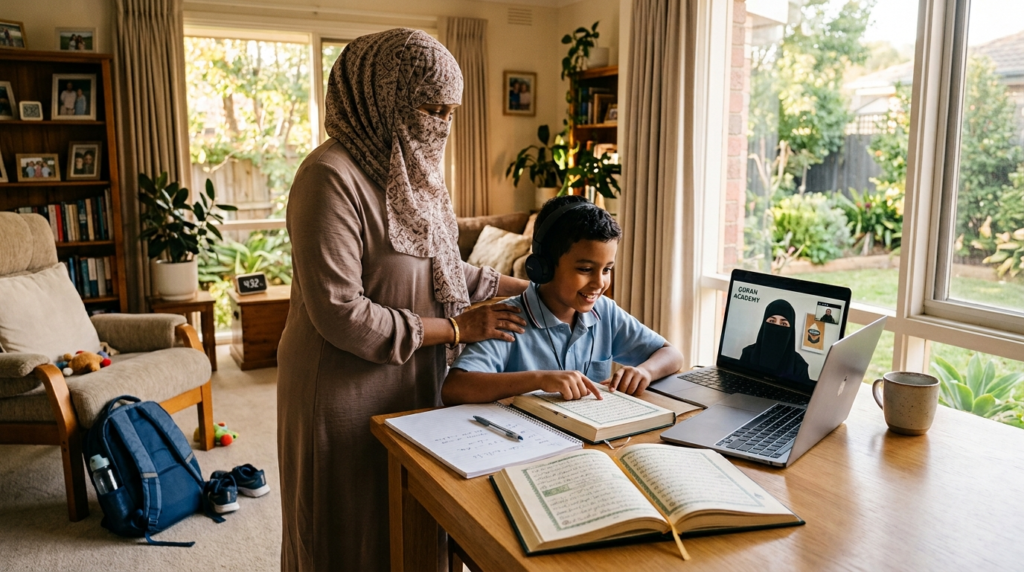
Step 1: Choose the right learning pathway
A beginner may start with Noorani Qaida before moving into Quran reading.
Another student may already read but need structured Tajweed correction. A more advanced learner may need Hifz, Muraja’ah, or focused recitation practice.
You can explore the available Quran courses in Australia to understand the learning options.
Step 2: Book a free trial class
A trial gives your family a chance to experience the lesson before making a longer commitment.
Parents can observe the teacher’s communication style. Children can also decide whether they feel comfortable learning with that teacher.
Step 3: Discuss the student’s level and goals
The teacher should understand where the learner is starting from.
A child struggling with Makhraj needs different support from an adult who wants to improve Tarteel or an advanced student working on memorisation.
Step 4: Set a suitable Australian schedule
The best schedule is one your family can follow consistently.
Parents should confirm lesson times in their Australian local time and consider AEST, AEDT, ACST, or AWST where relevant.
Step 5: Continue with regular lessons
Once the schedule is agreed, students follow a structured learning plan.
Regular attendance, short practice between lessons, and parent involvement can make the learning process more effective.
Why Quran Class Pricing Varies So Much Between Providers
There is no single Australian price for every online Quran course.
The monthly fee can change significantly depending on several factors.
One-to-one or group learning
One-to-one classes usually cost more because the teacher focuses entirely on one student.
The learner can ask questions immediately, receive direct correction, and move at a suitable pace.
Group classes may cost less, but teacher attention is shared between several students.
Lesson frequency
A student attending once or twice a week will usually have different monthly fees from someone studying five days a week.
More frequent lessons may suit children developing a regular reading habit or students working towards Hifz.
Session length
A short lesson and a longer lesson should not be compared by monthly cost alone.
Look at the total teaching minutes included each month.
Teacher experience and qualifications
Teacher experience and qualifications can affect pricing.
Parents should ask about Quran teaching experience, Tajweed knowledge, relevant certification, and Ijazah where appropriate.
Course type
Learning Noorani Qaida, basic recitation, advanced Tajweed, or Hifz can require different levels of teacher support.
That is why a beginner’s plan may not cost the same as a specialist learning pathway.
What’s Typically Included in a Fair Price?
A fair price should provide clear value rather than simply advertising the lowest monthly fee.
Before enrolling, check whether your plan includes:
- Live lessons with a clear structure
- One-to-one attention where advertised
- An experienced Quran teacher
- Learning at the student’s current level
- Tajweed and Makhraj correction where appropriate
- A structured curriculum
- Flexible Australian scheduling
- Transparent AUD pricing
- Progress updates for parents
- Clear cancellation or make-up policies
- No unexpected compulsory charges
The details matter because two providers can advertise similar fees while offering very different learning experiences.
One-to-One vs Group Quran Classes
| Factor | One-to-One Classes | Group Classes |
|---|---|---|
| Teacher attention | Dedicated to one learner | Shared between students |
| Learning pace | Personalised | More standardised |
| Corrections | Immediate and individual | Shared or limited |
| Scheduling | Usually more flexible | Often fixed |
| Cost | Usually higher | Often lower |
| Best suited to | Personalised learning | Families prioritising lower costs or group learning |
For a child who lacks confidence, one-to-one teaching can be particularly helpful.
The teacher can repeat a difficult sound, slow down when needed, or move forward once the child is ready.
Prices That Are Too Low, Hidden Fees, and No Trial Class
A low quran class price Australia search result may look attractive.
However, the advertised price does not always explain what your family actually receives.
Extremely low prices with unclear details
Ask how long each lesson lasts and whether classes are genuinely live.
You should also know whether the advertised price applies to one-to-one learning or group sessions.
Hidden or unexpected fees
Check for registration charges, required materials, cancellation fees, or other recurring costs.
A transparent provider should make the total cost easy to understand before enrolment.
No free trial class
A trial lets your child experience the teacher’s approach before you commit.
It also helps parents assess communication, lesson structure, and whether the child feels comfortable.
No clear teacher information
Parents should be able to ask about teacher experience, qualifications, and relevant screening.
Be cautious when a provider makes broad claims but gives families no meaningful information about its teaching team.
No progress reporting
You should know how your child’s learning will be monitored.
Without regular feedback, it can be difficult to tell whether your child’s reading, Tajweed, or memorisation is improving.
What Australian Families Should Budget for Monthly in AUD
There is no official Australian industry-wide price for online Quran classes.
Fees vary based on lesson frequency, session length, class format, teacher experience, and included support.
The most useful way to compare plans is to consider the total learning value rather than focusing only on the monthly AUD figure.
For example, Quran Classes Australia presents different live one-to-one plans based on lesson frequency, including weekend, three-day, and five-day options. The plans also use 30-minute lessons, showing why frequency and teaching time matter when comparing costs.
Before choosing a plan, ask:
- How many live lessons are included each month?
- How long is each lesson?
- Is the class one-to-one?
- Will my child have a consistent teacher?
- What experience or qualifications does the teacher have?
- How will parents receive progress updates?
- What happens if a lesson is missed?
- Are there any additional fees?
A slightly higher fee may offer better value if it includes more teaching time, individual attention, progress tracking, or a better fit for your child’s needs.
For the latest plan information, visit the Quran classes fees page.
How to Get the Most Value From Your Quran Class Fees
You do not need to choose the most expensive option.
You do need to compare what you receive for the price.
Start with a free trial class
Use the trial to see how the teacher interacts with your child.
Does the teacher correct mistakes patiently? Does your child feel comfortable asking questions?
These details can reveal more than a pricing table.
Compare the full package
Look at lesson frequency, session length, teacher attention, curriculum, and progress support together.
Ask about sibling rates
Families with multiple children should ask whether sibling rates or family arrangements are available.
This can make regular Quran learning more manageable for Australian households.
Check make-up class policies
School events, illness, and family commitments can affect attendance.
Before paying, understand whether missed lessons can be rescheduled and under what conditions.
Choose a routine your family can maintain
A cheaper plan is not better value if your child regularly misses classes.
A sustainable schedule gives your child more opportunity to build confidence and make steady progress.
Is Online Quran Class Safe for Children?
Safety should be part of your decision before you compare prices.
Quran Classes Australia presents its service around private one-to-one learning, structured teaching, flexible scheduling, and female teachers where requested. The site also highlights progress updates for parents.
Australian parents should still ask specific questions about any provider before enrolling a child.
1. Teacher qualifications
Ask about Quran teaching experience, Tajweed knowledge, and relevant certification.
For advanced recitation, families may also ask about Ijazah and the teacher’s Sanad where applicable.
Quran Classes Australia describes its teachers as qualified and experienced, with an emphasis on pronunciation, structured learning, and building student confidence.
2. Working With Children Check and safety measures
Australian parents should ask what screening and safeguarding procedures apply to teachers working with children.
This includes asking whether relevant Working With Children Check requirements are met in the circumstances that apply.
Parents can also ask about tutor identity checks, background screening, child-safe practices, and appropriate online communication.
Requirements can differ between Australian states and territories, so providers should explain their approach clearly.
3. Supervision and class structure
Parents should know who teaches their child and how lessons are conducted.
Quran Classes Australia offers live one-to-one lessons and describes a process that begins with a trial before regular classes are scheduled.
Clear class arrangements help parents understand the learning environment before enrolment.
4. Curriculum pathway
A structured pathway helps families understand how learning can develop over time.
A student may progress through:
Qaida → Quran Reading → Tajweed → Hifz or advanced Recitation → Ijazah
Not every student needs every stage.
A beginner may focus on Noorani Qaida and Makhraj, while another learner may need Tajweed correction or a structured Hifz and Muraja’ah routine.
Quran Classes Australia lists courses covering Noorani Qaida, Quran Recitation, Tajweed, and Quran Memorization.
5. Progress tracking
Parents should not have to guess whether their child is improving.
Quran Classes Australia states that parents receive regular updates, allowing families to follow progress and stay involved in the learning journey.
Ask what progress updates cover.
They might include reading accuracy, Tajweed, attendance, memorisation, or the next learning target.
Is an Online Quran Course Really Effective for Kids?
Online learning can work well for Australian children, but the format itself does not guarantee results.
The teacher, lesson structure, and family routine all matter.
One-to-one lessons can provide immediate correction when a child struggles with a letter or Makhraj.
The teacher can also adjust the pace instead of asking every child to follow the same timetable.
This matters for children who become discouraged when learning feels too difficult.
A patient teacher can repeat a sound, break a lesson into smaller steps, and recognise progress that a child may not notice themselves.
Parents also have an important role.
A consistent lesson time, a quiet learning space, and a few minutes of practice between classes can help turn lessons into a lasting habit.
Over time, the goal may be stronger recitation, improved Tajweed, or steady progress towards Hifz.
For many parents, the most meaningful result is seeing their child become more confident with the Quran and more willing to practise independently.
How Scheduling Works for Australian Families
Scheduling is one of the strongest practical reasons families choose online learning.
A child may need lessons after school, while a parent may prefer an evening or weekend session.
Families should also consider Australian time zones when choosing lesson times.
A suitable provider should confirm availability in the family’s local Australian time, including AEST, AEDT, ACST, or AWST where relevant.
Quran Classes Australia states that it offers flexible timings and schedules classes according to Australian local time, including morning, evening, and weekend options.
The best schedule is not necessarily the one with the most classes.
It is the schedule your child can follow consistently without making Quran learning feel like another stressful obligation.
Why Choose Quran Classes Australia Instead of a Generic Provider?
Australian families should look beyond the lowest advertised price.
Quran Classes Australia focuses its service on Australian learners and provides live one-to-one lessons, flexible scheduling, different course pathways, and female teachers where requested.
The course structure covers different stages, from Noorani Qaida and Quran reading to Tajweed, recitation, and Hifz.
This gives students room to progress according to their level instead of forcing every learner into the same starting point.
For parents, Australian-focused scheduling and AUD pricing also make the enrolment decision easier to understand.
The stronger differentiator, however, is transparency.
Families should be able to understand who teaches their child, how lessons work, how progress is communicated, and what safety measures apply.
The goal is not to choose a provider simply because it is the cheapest.
The goal is to choose a learning environment that your child can trust and your family can sustain.

Common Mistakes to Avoid When Choosing Affordable Online Quran Classes
Choosing the cheapest provider automatically
A low fee may suit your budget, but price should not be the only measure of quality.
Ignoring lesson duration
Always compare the actual number of teaching minutes included each month.
Not checking teacher qualifications
Ask about Quran teaching experience, Tajweed knowledge, and Ijazah where relevant.
Skipping safety questions
Ask about tutor screening, safeguarding, and relevant Working With Children Check requirements.
Forgetting to ask about progress
Find out how parents will know whether their child is improving.
Ignoring cancellation policies
Understand the process for missed or rescheduled lessons before paying.
Enrolling without trying a class
A free trial class gives your family an opportunity to assess the teacher, lesson structure, and learning environment.
Frequently Asked Questions
How much do online Quran classes cost in Australia?
Online Quran classes in Australia vary in price based on lesson frequency, session length, teacher experience, and class format. One-to-one lessons generally cost more than group classes. Families should compare the total teaching time, teacher attention, curriculum, and included support rather than choosing based only on the monthly AUD fee.
Are online Quran classes worth it?
Online Quran classes can offer good value for Australian families who need flexible scheduling and personalised attention. One-to-one lessons can reduce travel time, provide direct correction, and fit around school or work. The value depends on teacher quality, consistent attendance, suitable lesson structure, and a routine the student can maintain.
Is online Quran class safe for children?
Parents should ask about teacher screening, relevant Working With Children Check requirements, safeguarding procedures, lesson structure, and communication policies. It is also important to understand how parents receive progress updates. A provider should be willing to explain its safety approach clearly before a child begins regular lessons.
How can I find a qualified Quran teacher?
Ask about the teacher’s Quran teaching experience, Tajweed knowledge, and relevant qualifications. For advanced learning, you may also ask about Ijazah or Sanad where appropriate. Parents should consider whether the teacher has experience working with children and whether their teaching approach suits the student’s age, ability, and learning goals.
Is online learning effective for kids?
Online Quran learning can be effective when children receive consistent teaching from a suitable tutor. One-to-one lessons allow personalised pacing and direct correction. Results also depend on regular attendance, child engagement, reliable technology, parent support, and a clear learning pathway that matches the student’s ability.
Choosing Quran classes is about more than comparing quran classes fees.
You are choosing a teacher, a schedule, and a learning environment that can influence your child’s confidence and your family’s routine.
The right support can help a beginner move from Noorani Qaida to confident recitation. It can help a learner improve Tajweed or work steadily towards Hifz.
Most importantly, it can make regular Quran learning easier to maintain.
Book a free trial class and experience the teaching approach before committing to regular lessons.