
An ijazah is a formal authorisation from a qualified Quran teacher confirming that a student has mastered Quran recitation with accurate Tajweed. An online ijazah course allows eligible Australian students to work towards this authorisation through live, one-to-one lessons and a structured assessment under an experienced teacher.
If your goal is to improve your Quran recitation or help your child reach an advanced level, choosing the right online ijazah course is an important decision. Many Australian families begin with a free trial lesson to understand their current level before committing to a personalised learning plan.
Finding the Right Path to Advanced Quran Learning
For many Muslim families across Australia, learning the Quran is already part of the weekly routine. The challenge comes when a student is ready to move beyond basic recitation but cannot easily access an experienced teacher nearby. Between school, work and long travel times in cities like Melbourne, Sydney or Perth, attending advanced classes in person is not always practical.
An online learning environment removes many of these barriers. Students can learn from home at scheduled times that fit around school pickups, evening activities and family commitments. Instead of spending hours travelling, they can focus that time on meaningful practice and revision.
This is where an ijazah course becomes valuable. Rather than simply completing another Quran class, students work towards a recognised authorisation that reflects accurate recitation, careful study and consistent progress under a qualified teacher.
In this guide, you’ll learn what an Ijazah is, who should apply, how an online Ijazah course works and what Australian families should consider before choosing a provider.
Who Is This Guide For?
This guide is written for:
- Australian Muslim parents exploring advanced Quran education for their children
- Adult learners who want to perfect their Quran recitation
- Students with a solid foundation in Tajweed who are considering an Ijazah
- Families comparing online learning with local mosque classes
- Anyone wondering whether an online Ijazah course is the right next step
Whether you’re supporting your child’s Quran journey or returning to your own studies after years away, understanding the process helps you choose the right learning pathway with confidence.
What Does Ijazah Mean?
The word Ijazah means “permission” or “authorisation.” In Quran recitation, it is a formal approval granted by a qualified teacher after a student demonstrates accurate recitation according to the rules of Tajweed.
An Ijazah is much more than a course certificate. It confirms that the student has recited to the required standard under careful supervision and has met the teacher’s expectations for accuracy and consistency.
The authorisation is linked through a Sanad, or chain of narration, connecting each teacher to those who came before them. This tradition preserves the authentic method of Quran recitation from one generation to the next.
Ijazah in Tajweed
Many learners first hear about ijazah in Tajweed after becoming confident readers of the Quran. At this stage, the focus is no longer learning the rules but applying them consistently across every recitation.
Teachers pay close attention to pronunciation, rhythm, articulation points (Makhraj) and fluency (Tarteel). Small mistakes that might go unnoticed in general classes become important areas for improvement during advanced study.
Because of this, earning an Ijazah requires patience and regular practice rather than simply completing a set number of lessons.
Why an Ijazah Matters for Quran Reciters and Future Teachers
For many students, an Ijazah represents years of steady improvement. It reflects commitment to reciting the Quran accurately and respectfully, while building confidence through consistent guidance.
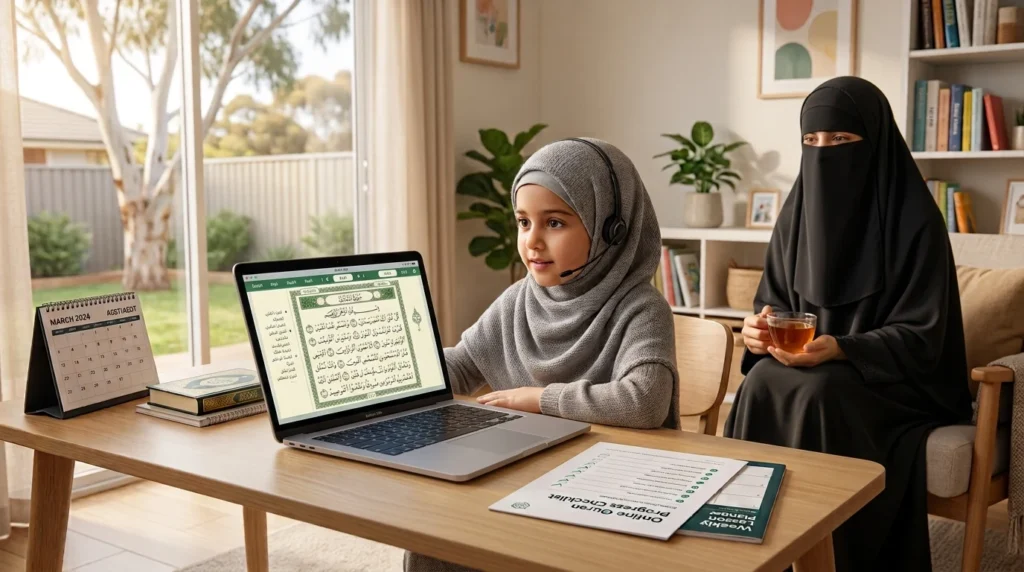
Practical Benefits
An Ijazah can help students:
- Strengthen their mastery of Tajweed
- Develop greater confidence in Quran recitation
- Learn through structured one-to-one lessons
- Receive detailed corrections from an experienced teacher
- Prepare for future teaching opportunities where appropriate
These benefits are developed gradually through careful study rather than rushed lessons.
Benefits for Australian Families
Parents often notice positive changes that go beyond pronunciation.
Children become more confident reading aloud because they receive regular encouragement and personalised feedback. Weekly lessons also become easier to maintain when they fit naturally around Australian school hours and family routines.
For adult learners, studying from home removes one of the biggest barriers to consistency. Instead of trying to attend classes after a long commute, they can schedule lessons during convenient evening or weekend times using AEST/AEDT availability.
Many families also find that a structured learning plan encourages better daily habits. Even ten or fifteen minutes of revision each day can make steady progress feel achievable.
Who Is Eligible to Start an Ijazah Course?
One of the biggest misconceptions is that every student should enrol in an Ijazah course as soon as they finish learning to read the Quran.
In reality, an Ijazah is an advanced stage of study. Most learners first need to build a strong foundation in recitation before beginning formal assessment.
Students are generally expected to have:
- Fluent Quran reading skills
- Strong knowledge of Tajweed rules
- Accurate Makhraj (articulation points)
- Consistent daily revision
- Commitment to regular lessons
- A willingness to accept detailed correction
Before recommending an Ijazah pathway, a teacher will normally listen to the student’s recitation and identify areas that still need improvement.
Some learners are ready to begin immediately. Others benefit from spending additional time strengthening Tajweed before moving forward.
If more preparation is needed, students can first complete our online Quran courses before progressing to a dedicated recitation course. Building confidence step by step often leads to better long-term results than rushing into advanced study.
A good teacher focuses on readiness rather than speed. Every student develops differently, and taking the time to build strong foundations makes the journey towards an Ijazah far more rewarding.
How Does an Online Ijazah Course Work?
Many parents assume an online ijazah course is simply a series of advanced Quran lessons. In reality, it follows a structured process that helps students refine their recitation before any final assessment takes place.
While every teacher has their own teaching style, the overall journey is usually similar.
Step 1: Initial Recitation Assessment
The first lesson focuses on understanding the student’s current level.
Your teacher listens carefully to your recitation and identifies strengths as well as areas that need improvement. This assessment helps determine whether you’re ready to begin Ijazah preparation or whether more work on Tajweed is recommended first.
For parents, this stage also provides realistic expectations. Instead of making promises about quick completion, a good teacher explains the skills your child needs to develop before moving forward.
Step 2: A Personalised Learning Plan
No two students progress at the same pace.
After the assessment, your teacher creates a learning plan based on your recitation level, goals and availability. Lessons are scheduled around Australian family routines, making it easier to maintain consistency during school terms and holidays.
Some students spend extra time improving pronunciation. Others focus on strengthening fluency or correcting recurring Tajweed mistakes before progressing further.
A personalised plan keeps lessons purposeful and avoids unnecessary repetition.
Step 3: Live One-to-One Quran Lessons
Individual lessons give students the opportunity to recite without distraction.
Because the teacher listens to every verse in real time, corrections can be made immediately. Small pronunciation errors are addressed before they become habits, helping students improve steadily over time.
Many Australian parents prefer one-to-one classes because their child receives the teacher’s full attention throughout the lesson rather than sharing learning time with a larger group.
Step 4: Detailed Tajweed Correction
At this stage, lessons become increasingly detailed.
Teachers pay close attention to:
- Correct Makhraj (articulation points)
- Consistent application of Tajweed rules
- Smooth and measured Tarteel
- Fluency throughout longer passages
- Repeated pronunciation mistakes
Students are often surprised to discover small errors they have repeated for years. Careful correction helps build confidence with every lesson.
Step 5: Muraja’ah (Revision)
One of the most valuable parts of advanced Quran study is Muraja’ah, or revision.
Rather than constantly moving to new sections, students regularly revisit previously learned passages. This strengthens accuracy and helps maintain consistent recitation over time.
Experienced teachers often notice that students who revise a little each day make more reliable progress than those who only practise before lessons.
Step 6: Comprehensive Evaluation
When a teacher believes the student is ready, a thorough assessment takes place.
The evaluation considers:
- Accuracy of recitation
- Application of Tajweed
- Fluency and confidence
- Consistency across different Surahs
- Readiness for advanced authorisation
This assessment is designed to reflect genuine ability rather than test memorisation alone.
Step 7: Receiving the Ijazah
If the required standard has been achieved, the teacher may grant an Ijazah together with its authenticated Sanad (chain of narration).
Receiving an Ijazah is an important milestone. It represents years of careful learning, regular revision and consistent guidance from a qualified teacher.
How Long Does an Online Ijazah Course Take?
This is one of the most common questions Australian families ask.
The honest answer is that there is no fixed timeline.
The length of an ijazah course depends on several factors, including:
- Your current recitation ability
- Your understanding of Tajweed
- Lesson frequency each week
- Daily revision at home
- Progress shown during teacher assessments
Some learners already have advanced recitation skills and mainly need refinement. Others require additional months of guided practice before reaching the required standard.
A reputable academy will never promise an Ijazah within an unrealistically short period. Quality learning takes time, and steady improvement is far more valuable than rushing towards certification.
Online Quran Recitation Course vs Online Ijazah Course
Many students are unsure whether they should improve their recitation first or begin preparing for an Ijazah immediately.
The table below highlights the difference.

| Feature | Quran Recitation Course | Online Ijazah Course |
|---|---|---|
| Main purpose | Improve recitation and Tajweed | Work towards formal authorisation after assessment |
| Suitable for | Beginner to intermediate learners | Advanced students with strong Tajweed |
| Teacher focus | Building confidence and accuracy | Refining every aspect of recitation |
| Assessment | Ongoing lesson feedback | Comprehensive evaluation before Ijazah |
| Outcome | Improved recitation skills | Ijazah with Sanad if all requirements are met |
If you’re uncertain which pathway is right for you or your child, starting with a professional assessment is usually the best option. Many learners complete a recitation course before progressing to advanced Ijazah study.
Is an Online Ijazah Course Effective for Australian Students?
Some parents wonder whether online learning can provide the same quality as face-to-face Quran lessons.
The effectiveness of an online course depends far more on the teaching approach than the technology itself.
Live one-to-one lessons allow teachers to hear every recitation, provide immediate corrections and adapt each lesson to the student’s progress. This level of individual attention is often difficult to achieve in larger classes.
For families across Australia, online learning also removes practical challenges. Students living in busy metropolitan areas or regional communities can access qualified teachers without long travel times.
Flexible AEST/AEDT scheduling also helps children attend lessons consistently alongside school, homework and extracurricular activities.
Parents often find that learning from home creates a calmer routine. Instead of rushing to arrive at a lesson on time, children can prepare, revise and begin their class in a familiar environment.
Consistency remains the biggest factor in success. Students who attend lessons regularly and practise between classes are far more likely to build confident, accurate recitation than those who study only occasionally.
What Should You Look for in an Online Quran Academy?
Choosing an academy is about much more than comparing lesson fees. Parents want reassurance that their child will learn in a structured, supportive environment with teachers who value steady progress over quick results.
When comparing providers, these are the factors worth considering.
Qualified Teachers
A student working towards an Ijazah needs guidance from an experienced Quran teacher with advanced knowledge of Tajweed and Quran recitation.
Before enrolling, ask questions such as:
- How is the student’s level assessed?
- How are recitation mistakes corrected?
- Is the learning plan personalised?
- What support is available if a student needs more time?
An experienced teacher focuses on helping students improve with confidence instead of rushing them through lessons.
Child Safety and Learning Environment
Safety is naturally a priority for Australian families.
Look for an academy that has clear communication with parents, structured online lessons and appropriate safeguarding practices. Where relevant, ask whether the provider follows Australian child safety expectations, including Working With Children Check requirements for teachers.
Parents should feel comfortable discussing their child’s progress and understanding how lessons are delivered.
Clear Lesson Structure
Children usually learn more effectively when every lesson follows a consistent routine.
A well-planned lesson often includes:
- Quran recitation
- Immediate Tajweed correction
- Revision of previous work
- New learning goals
- Time for questions and feedback
This structure helps students stay engaged and understand exactly what they are working towards.
A Clear Learning Pathway
An Ijazah is rarely the starting point.
Most learners progress through a structured pathway:
- Qaida or Noorani Qaida
- Tajweed
- Quran Recitation
- Hifz (for students who choose memorisation)
- Advanced preparation for an Ijazah
Taking one step at a time builds stronger recitation skills and greater confidence.
Keeping Parents Informed
Regular communication helps parents stay involved in their child’s learning.
Useful progress updates may include:
- Feedback after lessons
- Areas needing extra revision
- Achievement of learning goals
- Recommendations for home practice
Small improvements each week often lead to lasting confidence over time.
Why Australian Families Choose Quran Classes Australia
Australian families often need more flexibility than traditional classroom schedules can provide.
Lessons that fit around AEST/AEDT time zones make it easier to balance Quran learning with school, work and family commitments. Students can learn from home without spending additional time travelling across the city after a busy day.
Quran Classes Australia provides personalised one-to-one online lessons designed for Australian learners. Students can begin with foundational study, strengthen their Tajweed, improve their Quran recitation and progress towards more advanced learning when they are ready.
The learning journey is designed to move at the student’s pace. Rather than encouraging every learner to pursue an Ijazah immediately, teachers first help students develop the strong recitation skills needed for long-term success.
Families also value the opportunity to begin with a free trial class before deciding on the most suitable learning pathway.
Common Mistakes to Avoid Before Starting an Ijazah Course
Avoiding a few common mistakes can make the learning journey smoother and more rewarding.
Starting Before You’re Ready
An Ijazah is an advanced stage of Quran study. Building a strong foundation in Tajweed first usually leads to better long-term results.
Choosing a Course Based Only on Price
Affordable lessons are important, but teaching quality, personalised feedback and structured learning provide greater value over time.
If you’re comparing providers, consider the overall learning experience rather than focusing only on class fees in AUD.
Ignoring Teacher Experience
Before enrolling, ask how teachers assess students, provide feedback and support long-term improvement.
The relationship between teacher and student often has the greatest impact on progress.
Expecting Fast Results
Every learner develops at a different pace.
Consistent attendance, regular revision and patience are far more important than completing an Ijazah as quickly as possible.
Skipping Daily Revision
Even short revision sessions can make a noticeable difference.
Students who spend ten to fifteen minutes revising each day usually retain their learning more effectively than those who only practise before lessons.
Frequently Asked Questions
Is an online Ijazah recognised?
Yes. An online Ijazah can be recognised when it is awarded by a qualified teacher after the student successfully completes the required recitation and Tajweed assessment. The quality of the supervision and the authenticity of the assessment matter more than whether lessons are delivered online or in person.
Can beginners enrol in an online Ijazah course?
Most beginners are encouraged to first develop strong Quran reading and Tajweed skills. A teacher will normally assess your recitation before recommending whether you’re ready for advanced Ijazah study.
How long does an online Ijazah course take?
There is no standard timeframe. Progress depends on your current recitation level, lesson frequency, daily revision and the teacher’s assessment of your readiness.
Is online Quran learning effective for children?
Yes. Live one-to-one lessons allow teachers to provide immediate feedback and personalised guidance. When children attend regularly and revise between lessons, online learning can be highly effective.
What should I look for in a qualified Quran teacher?
Look for a teacher who demonstrates strong Tajweed knowledge, follows a structured teaching approach, communicates clearly with parents and encourages steady improvement rather than rushing through the curriculum.
Start Your Journey Towards an Ijazah
An online ijazah course is more than an advanced Quran programme. It is a structured journey that helps students refine their recitation, strengthen their Tajweed and work towards a respected authorisation under the guidance of a qualified teacher.
For Australian families, flexible AEST/AEDT scheduling and personalised one-to-one lessons make it easier to stay consistent while balancing school, work and everyday commitments. Whether your goal is to prepare your child for advanced Quran study or improve your own recitation, choosing the right learning pathway can make all the difference.
If you’re unsure where to begin, the best first step is a personalised assessment. Book a free trial class with Quran Classes Australia to discuss your goals, assess your current recitation level and discover whether an ijazah course is the right next stage in your Quran learning journey.